Skip links

Neck and Headache Therapy

The upper portion of the spine plays an important role in stabilising the head, whilst also providing a protective pathway for nerves between the brain and the body.  Many nerve endings in the neck, along with the close connections to the brainstem, make the neck an important part of any assessment related to whiplash, dizziness, concussion and headaches.

Studies have shown that pain and/or dysfunction in the neck has implications towards the smoothness of eye movements, orientation of the head, migraine / headaches symptoms and balance.  In particular, the suboccipital muscles, a group of muscles under the base of the skull, are intricately linked to the ability of the eyes to maintain focus on a target, as well as the stability of the head and neck.  Although the suboccipital muscles play a role in movement of the head, they also contain a dense number of muscle spindles, making them also very important for sensing the “position” of the head.  Interestingly, the eyes and the suboccipital muscles are connected in a way that when the eyes move, the suboccipital muscles engage.  You can feel this connection by gently placing your fingers below your skull, and moving your eyes side to side. 
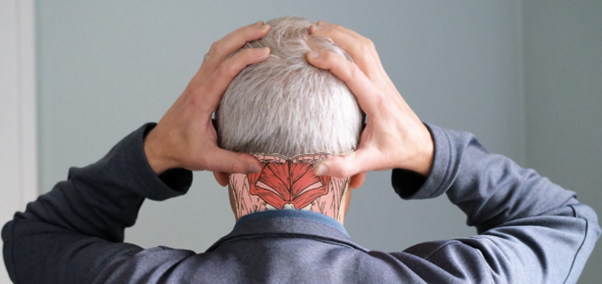
Treatment for the neck, or cervical spine, may occur in various forms.  The primary goals of treatment are to: 

  • Decrease sensitivity in areas of the neck 
  • Restore full range of motion
  • Improve posture of the upper spine
  • Improve strength of supporting muscles of the neck 
  • Regain accurate awareness of neck position

It is often that the neck will respond well to some gentle manual therapy and massage, along with stretching and strengthening exercises.  The use of a mirror is also helpful in explaining the correct position of the head and neck. 

Head lasers are another useful tool for neck rehabilitation, as they can give the user an accurate sense of head motion, demonstrated by the laser on the wall.  The head laser is a great tool for improving awareness of neck position.   

In summary, the neck can cause many symptoms to do with head and brain dysfunction, due to it’s close relationship with both.  It is necessary to assess the neck for potential involvement in symptoms, for it may be that improving neck function serves a critical part to improving quality of life. 

Concussion

Learn more about concussion and how it is assessed and treated.

Baseline testing

A pro-active effort towards better brain health of athletes at risk of concussion.

Neuro-questionnaire

Complete our neuro-questionnaire.