What is a concussion?
To understand concussion, first, we must do a quick review of the brain and how it works. The human brain is made up of approximately 100 billion interconnected neurons, each of which carries out a certain function. The function of the neuron depends upon which part of the brain to which it belongs. Many neurons connect as networks to transfer and transform signals to and from different regions of the body and brain. Think of these neurons like little soldiers, all carrying out certain roles in the army.
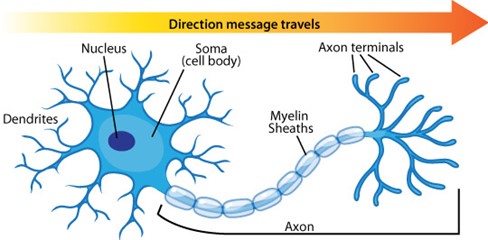
Although everyone’s brain is different, in many ways, all brains have consistent pathways and structures with similar functions. For example, we know through science that the cerebellum gives us coordination and balance, whilst the frontal lobe gives us rational thought and planning capabilities. And because of these similarities, we can look at functions such as these and measure them to assess the correlating regions of the brain. The diagram below shows the summarized function of various parts of the brain.

An important part of neuron function is energy production. Energy is produced within the neuron, via the fuel supply delivered via blood-flow. For sustained brain function, there needs to be sustained fuel delivered to the neurons, and sustained energy production from within the neuron.
So, what exactly happens when a brain receives trauma?
Often, but not always, this is the result of a direct blow to the head, resulting in likely bruising or laceration to the skin, and perhaps even damage to the skull. The thing to remember is that the brain is so delicate that it need only be momentum that would cause the brain to “knock and twist” within the bony confinement of the head. For this reason, whiplash or a jolt from a fall could cause concussion, without any direct impact to the head.
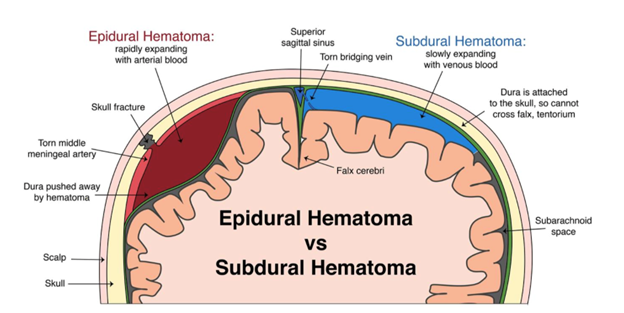
Whenever a head injury has occurred, the initial concern is around the possibility of some nasty things happening – specifically an epidural or subdural haematoma, parenchymal haemorrhage or increased intracranial pressure. If there is a reason to suspect significant head or neck injury, the first thing to do is to scan the areas to exclude these life-threatening possibilities. The diagram below explains some of these medical terms.
Of course, when there is a blow to the brain, there will be direct damage to the brain itself. This causes neurons to disintegrate in damaged areas. One way to think about it is like this – when there is a blow to the head, this would be like dropping a bomb on the army of soldiers; there is bound to be some soldiers lost, depending on where the bomb dropped.
But with concussion, there is also a more widespread issue, affecting the wider army, whereby the soldiers cannot get their supplies. In this way, the soldiers are disabled, not necessarily from direct damage, but from the prolonged loss of fuel supply and energy production.
More specifically, the concussed brain is said to have an energy crisis, whereby the fuel demands of the injured neurons are higher than usual, yet the blood flow and delivery of fuel to the brain is compromised. This causes a problem whereby the neurons in the brain cannot continue to carry out their designated function, resulting in a brain which is quick to fatigue. The diagram below shows the extensive network of blood vessel into the head.

Due to the many various functions of the brain, it is not surprising to learn that there are many different symptoms to a brain injury. In 2016, a group of experts came together in Berlin for a worldwide conference on concussion. The panel of experts collectively nominated 22 of the most common symptoms that are possible with concussion. These symptoms are tabled below:
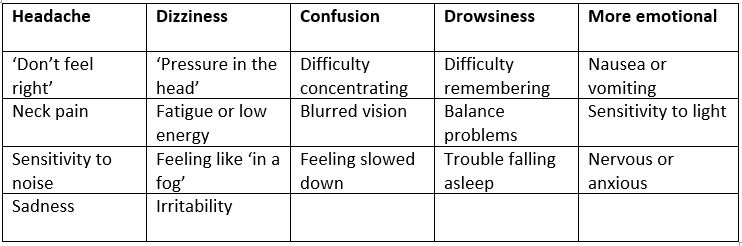
Unfortunately, many victims of concussion will experience most, if not all, of these symptoms, giving rise to the life-changing effect of the injury.
According to information given on the Queensland Brain Institute, a traumatic brain injury (TBI) is broadly classified as a “mild” if there is loss of consciousness for less than 30 minutes, and amnesia for less than 24 hours. Anything beyond these parameters would fall into the categories of moderate or severe TBI.
Concussion is considered to be a mild TBI, yet the outcome of concussion can be perpetual and catastrophic to the victim, and I can think of many clients who would strongly disagree with the use of the word “mild” in the description of the impact and suffering to their lives.
Because of the direct blow of a head injury, there is also the compounding effect of brain inflammation. The inflammatory reaction is a crucial part of the brain healing, as it is for any injured body part, however, the inflammation can also trigger a wide-spread series of ongoing reactions which turns the brain into a heightened state of vigilance.
In some cases, this hypervigilance can become chronic. This process can be at least partly attributed to the role of the microglial cells in the brain. When functioning under normal circumstances, microglial cells are essential in maintaining a clean environment for the brain. But when these microglial cells are “primed” from something like a concussion, they change shape and have a tendency to moprh into a pro-inflammatory, M1 phenotype, shown in the diagram below.
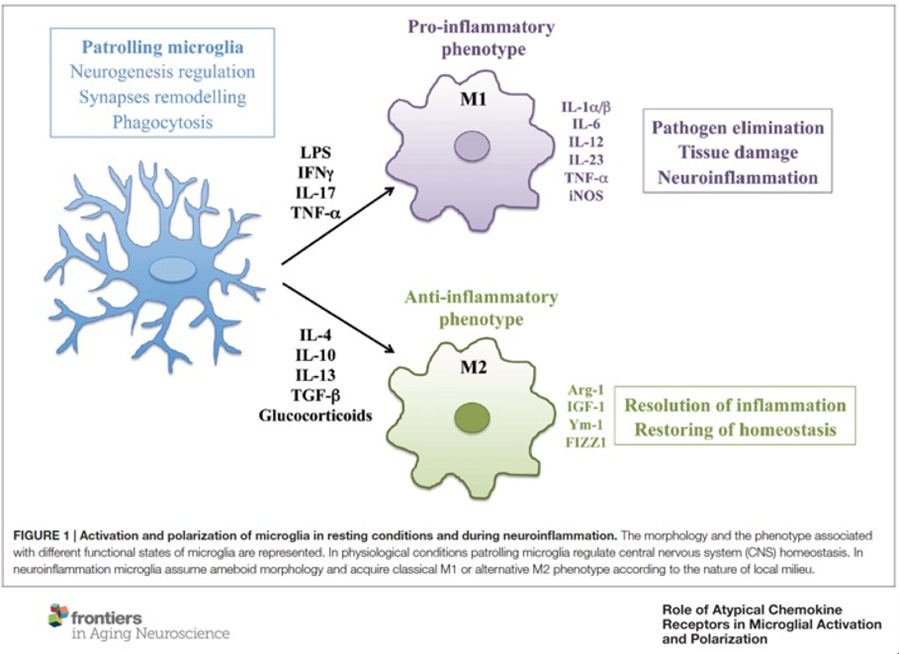
The M1 phenotype then destroys neurons, to create a state of destruction, beyond inflammation. It is often the case that this vigilant state makes the brain extremely sensitive to stress or challenges, whilst remaining in an inefficient and symptomatic state of disrepair. The changes of the microglial cell are a normal part of the healing response, however, we don’t want these microglial cells to STAY primed in the M1 state.
The sensitivity and low energy production of the concussed brain means that it is more likely to be overwhelmed by the many different tasks required during a normal day. These challenges, which we may take for granted when we are healthy, can quickly fatigue an injured brain, and come in the form of seemingly simple things, such as reading, listening to a conversation, walking down a shopping aisle, concentrating on a topic or even focusing on a visual target.
Concussion victims will often find that they simply cannot fit into their day, what they could pre-concussion. To make matters worse, once the brain is fatigued, this will create more stress and inflammation, causing a downward spiral.
Unlike an injury to a ligament or tendon, a concussion is invisible on an MRI brain scan, and there is no readily available blood test that can detect its presence. Therefore, concussion is often rated or measured via clinical assessment.
Not only are concussions inconspicuous, but they are also heterogeneous, meaning that each concussion is as unique as a fingerprint. This can be attributed to the uniqueness of every brain. Complex neural networks are intertwined with the mysteries of the human psyche to create a non-linear system which is extremely challenging to understand, assess and treat.
Of course, the explanation of concussion is a topic which simply cannot be covered in a short article, however, we must start with an understanding of the physiology of concussion, and a knowledge of brain function. From here, we can use organized logic and begin to assess and understand the key aspects of an individual brain injury, which can then lead to the appropriate interventions.